But then uh you had other things going on. One time when I was asking him about his military training said once I learned all that stuff then we could use it to fight the Japanese and even his son was like he was like he's never said that before. Okay. You never know what's going to survive as a colonized person.
I was talking to one other person who was in his central Japanese and on the surface he was like a model student, you know, he spoke fluent Japanese. I think they were even like a national language household. So, uh, they spoke Japanese at home and the Japanese would reward this by giving you extra fancy white sugar instead of brown sugar and like you got all these, um, he was allowed to go to a Japanese only school. His family kept their ancestral tablets like in a hiding place. Some of these were like confiscated and taken away by the Japanese. They managed to hide them and also You never go to the Japanese police
as a Taiwanese if we had a problem in our community
by ourselves.
We had a pretty complete underground government. And he started talking about us and then he started talking about like the lord of hell yama and I was like oh you mean like a thief like so he was talking about the city god temple. So they would go the people who had a conflict would go to the temple in front of the gods and you know if you swear oh that's true was part of it but also in the presence of the gods you had better not lie right. So they could solve their problems amongst themselves.
That was so fascinating to me. So you think you know what's going on versus their relationship to Japan and on the surface we see very pro-Japanese, you know, um and certainly there's those strong cultural ties and the good feelings as well, but
what's going on under the surface. I think there's a strong
in a lot of that we don't belong to any
had this feeling. Yeah. So I hope I answered your question in particular
feelings.
Thank you for bringing that up. Important part
questions.
I'm curious about
those he has
I mean they have a pretty extensive home. This this was part of the inheritance that he had lost. He went and just kind of looked from the outside. Um was kind of you know it was kind of a traditional Taiwanese three walled courtyard with different places where the extended family lived. I think they were middle class. I don't think they were of
But um yeah, I was middle class. There were stories told about his father. His father was a big gambler and then kind of ran away. Uh some say he ran all the way to the east coast and escaped his death. So um that I think his family also went through a hard time.
kind of maybe that's a really good point actually certainly there was a Japanese speaking elite that was very very pro Japanese there's all these different kind of gradations of it so during the Japanese era you had people who were totally anti-Japanese and chose to associate with China or Chinese Communist Party. But then you have the
right so the culture association. Exactly. Right. Um based in um part of that big family. Um so their position was kind of nuanced. It was we are going to assert our Taiwanese identity within the larger Japanese polity and we should be have our own legislature. advocating for reform but not for independence.
Yes. who's not one of the super privileged households.
That's join me for a round of applause.
Also, Leona told me that we need to go downstairs as well as they're ending the events downstairs. Thank you.
That's right.
兒童節目|東灣台灣人協會 雙語故事時間
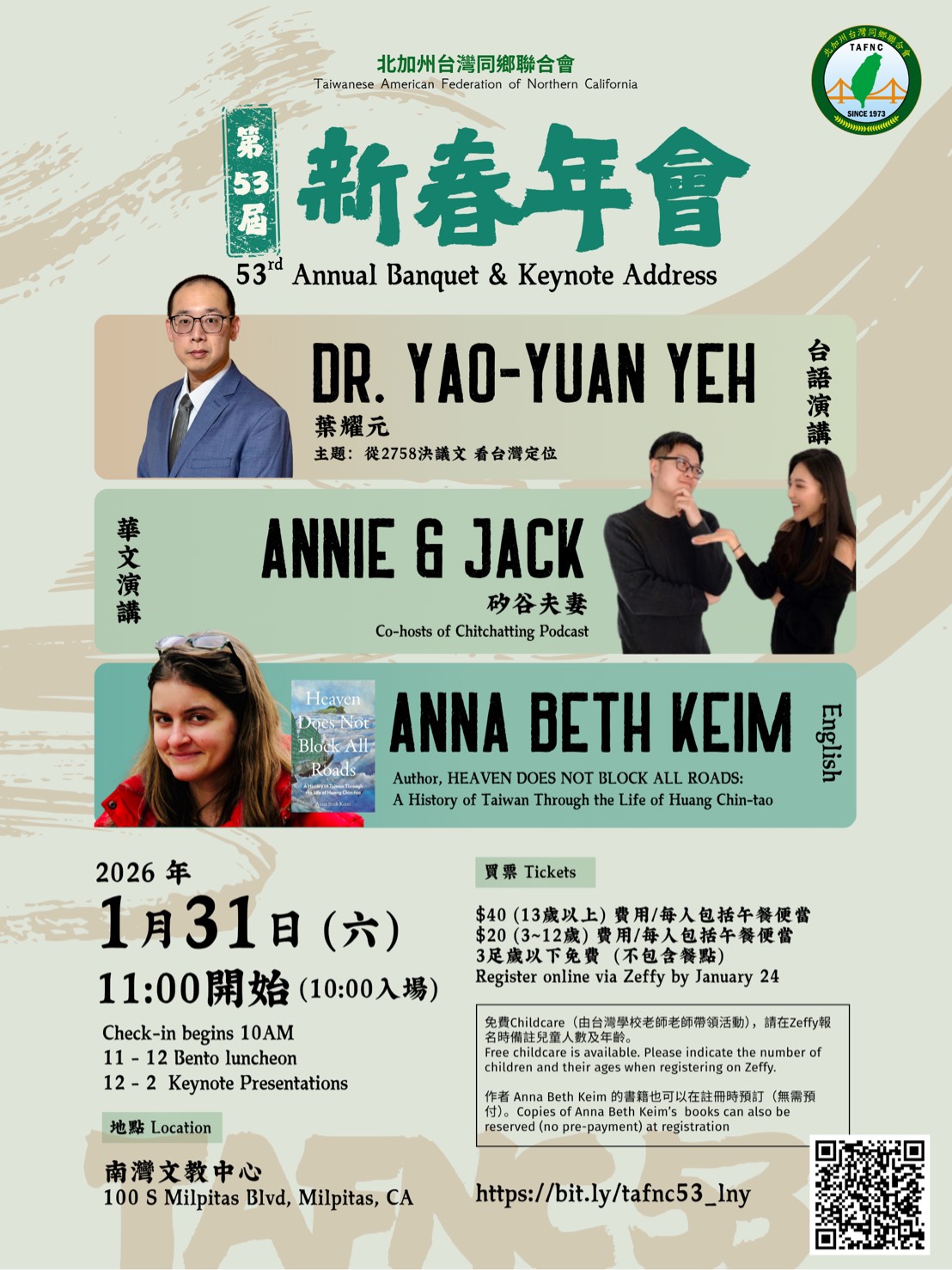
活動提供免費Childcare(由台灣學校老師帶領),報名時請註明兒童人數與年齡。
票務資訊
13歲以上:$40(含午餐便當)
3至12歲:$20(含午餐便當)
3歲以下免費(不含餐點)
學生折扣: Promo Code TAFNCSTUDENT at checkout for $10 off (please bring ID)